If you spend your evenings reading about sports, local news or home projects, you already know how much of daily life now runs through screens, and how quickly AI tools have slipped into ordinary office work. Summaries, drafts and meeting recaps are produced in seconds, and employers have started asking who can actually judge that output. Microsoft's AB-730 certification is one answer to that question. This article looks at the practice material for it and at Microsoft Certified: AI Business Professional (AB-730) on the Be Ready Education site, including what it offers, where it stops, and how to begin.
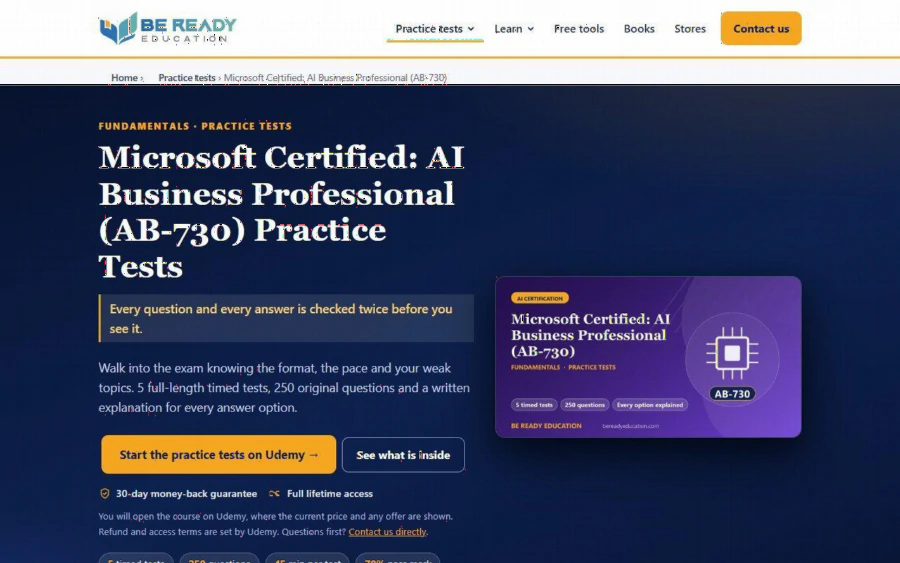
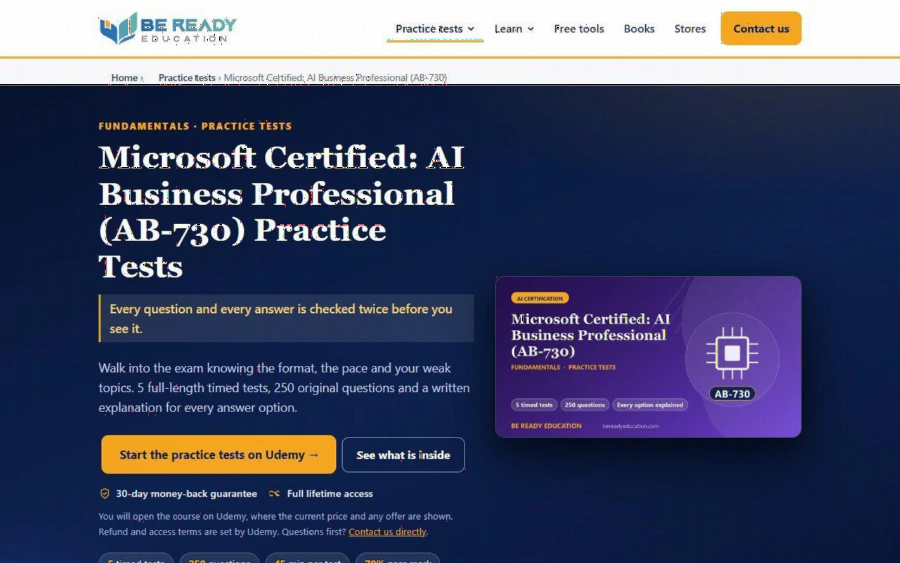
The Be Ready Education practice test page for Microsoft AB-730, showing the course cover, 250 questions and 45 minutes per test
What the exam is for
According to the exam page, AB-730 sits at the Fundamentals level and is aimed at business analysts and operations or marketing professionals who use AI in their work. The page describes the exam as covering AI and Copilot in business roles, and it sends readers to the provider's own exam guide for the official objectives rather than listing them itself. That is worth noticing. The practice site does not pretend to replace the vendor's documentation.
The official details the page quotes are simple. The exam is proctored and scheduled through Pearson VUE, it lasts 45 minutes, a score of 700 or greater is needed to pass, and a retake is allowed 24 hours after a first attempt. The page also says formats, fees and rules are set by the provider and can change, so confirm them on the official page before you book. I would repeat that advice. Anything you read on a third-party site, including this article, is a snapshot.
What the practice set contains
The listing shows five full-length timed tests with 250 original questions in total, which works out to 50 questions per test and 45 minutes for each one. That is roughly 54 seconds per question, and it is the most useful number on the page. Many candidates know the material and still lose points because they read slowly or second-guess themselves. A timed set forces you to practice pacing before the exam does it for you.
Every answer option comes with a written explanation covering why the right answer is right and why each wrong answer is wrong. This matters more than the question count. If you only learn which letter was correct, you learn very little. If you read why a plausible distractor fails, you start to see how exam writers build traps.
The page highlights a few concept pairs that tend to cause confusion: prebuilt agent versus custom agent, real-time catchup versus intelligent recap, Copilot Pages versus notebooks, and hallucination versus prompt injection. The last pair is the one I would study twice. Mixing up a made-up fact with a malicious instruction hidden in content is exactly the kind of slip a business user can make at work.
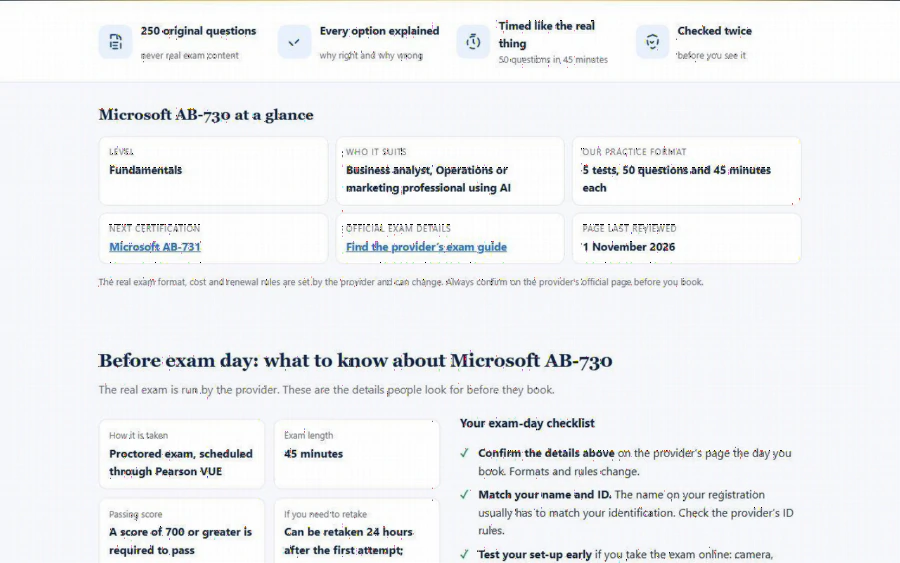
The Microsoft AB-730 at a glance section, listing level, audience, practice format and official exam details
The page also lists free tools: an exam timer, a pass score calculator, a practice score tracker, and a study plan with two-week and four-week schedules. There is a readiness check that asks for your latest practice score and an optional exam date, and the page states that nothing is saved or sent.
A sample question and how to think about it
The page shows one sample question. A manager receives a Copilot summary that includes a statistic that may be wrong, and the correct answer is to verify the figure against its cited source before sharing it. It is a modest example, but it captures the spirit of a fundamentals exam. The test is less about clicking through menus and more about judgment: trust, check, then share.
Here is an illustration, clearly invented for this article. Imagine an operations coordinator who uses Copilot to condense a long supplier thread. The summary says delivery times fell by a third. Before forwarding it, she opens the cited message and finds the figure refers to a single supplier, not the whole group. A question like the one on the page is training exactly that habit, and the habit is worth having whether or not you ever sit the exam.
Strengths and limits
The strengths are fairly clear. The tests are timed to match the format, the questions are original, the explanations cover every option, and the study tools are free to use. The page also says plainly that the questions are never real exam content, and that the publisher is independent and not affiliated with or endorsed by Microsoft. That honesty is a point in its favor, because material that claims to reproduce the live exam is both unreliable and risky.
The limits matter just as much. The page does not list a detailed objective breakdown, so you will need the official exam guide next to it. The course is delivered through Udemy, where the current price and any offer are shown; the exam page itself does not state a price, so I will not guess one. Refund and access terms, including the 30-day money-back guarantee and full lifetime access mentioned on the page, are set by Udemy. And no practice set can promise a pass. A score on mock papers is a signal about readiness, not a guarantee about the real result.
Who should use it, and who should not
This kind of set suits people who already use AI tools at work and want to turn informal experience into a checkable credential. It also suits candidates who struggle with time pressure, because the timed format gives you a way to measure it. If you prefer to learn through structured questions rather than long video lessons, the explanation-heavy style is a good match.
It is a weaker fit if you have never touched Copilot or any similar tool. In that case, spend a few weeks using the tools on real tasks first, and read the vendor's learning material. Practice tests measure what you have already absorbed; they are not a first introduction. It is also not for anyone hoping to memorize answers. With original questions, that approach has nothing to hold on to.
How to get started
A sensible plan has four steps. First, read the official exam guide from the provider and note the topic areas. Second, take one practice test cold, under the 45-minute limit, without looking anything up. Third, read every explanation, including those for questions you got right, and write down the concept pairs you keep mixing up. Fourth, repeat with the remaining tests, using the tracker to watch your scores by topic.
The page suggests aiming for 80 percent or higher on two tests in a row before booking, and it uses a 70 percent pass mark on its own practice tests. Those are the publisher's guidelines, not Microsoft's rules, but they are a reasonable personal threshold. If your scores sit below that, use the two-week or four-week study plan on the site and retest.
When you are ready to see the full details, the exam practice library lists the other certification tests from the same publisher, which is useful if AB-730 is the first step of a longer path. The AB-730 page itself points to Microsoft AB-731 as the next certification.
Final thoughts
AB-730 is a modest, practical credential, and the best preparation for it is modest and practical too: learn the format, practice the pace, understand why wrong answers are wrong. The Be Ready Education set is built around that approach, with clear limits stated up front. Check the official provider page for current exam rules, check Udemy for the current price, and treat your practice scores as a guide rather than a promise. Used that way, it is a sensible way to spend a few focused weeks.