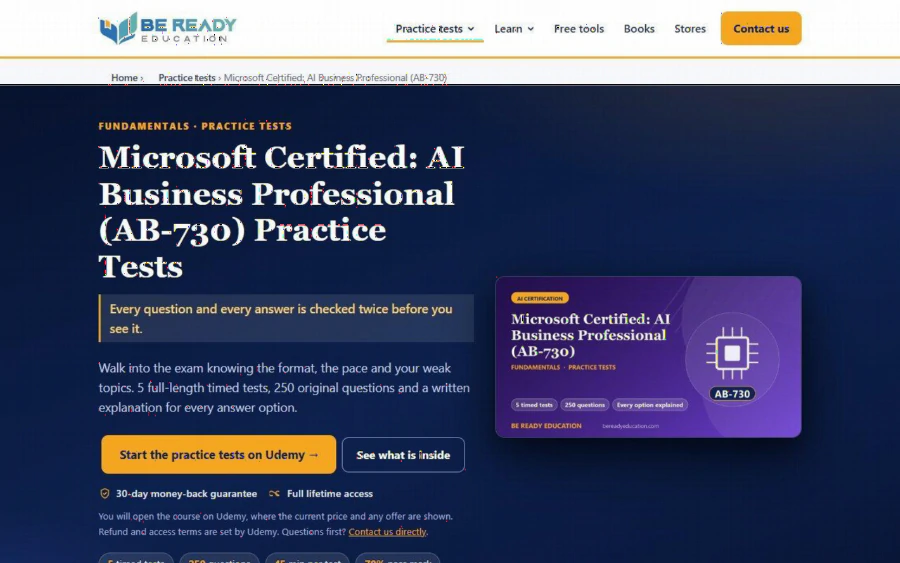
Most people who sit a Microsoft fundamentals exam are not new to their jobs. They are analysts, marketers, operations leads and coordinators who already use Copilot every week and now want a credential that shows it. The knowledge is usually there. What goes wrong is the format, the clock and the wording of the questions. This article looks at one independent set of timed AB-730 mock papers, what the practice material covers, where it falls short, and how to start.
What the AB-730 exam is about
The Microsoft AI Business Professional exam, known by its code AB-730, is about using AI and Copilot effectively in business roles. It is rated at the fundamentals level, so it does not ask you to write code or build models. It asks whether you can choose the right AI feature for a task, understand how agents and meeting tools behave, and recognise risks such as made-up answers or hidden instructions in a document.
According to the practice-test page from Be Ready Education, the provider's exam is proctored and scheduled through Pearson VUE, runs for 45 minutes, and needs a score of 700 or greater to pass. The page also says it can be retaken 24 hours after the first attempt, with longer waits for later retakes under Microsoft's retake policy. These details were checked by the site on 1 November 2026, and the page itself tells you to confirm everything with the provider before you book, because formats and rules change. Treat that advice seriously. Fees, objectives and policies belong to Microsoft, not to a third-party study site.
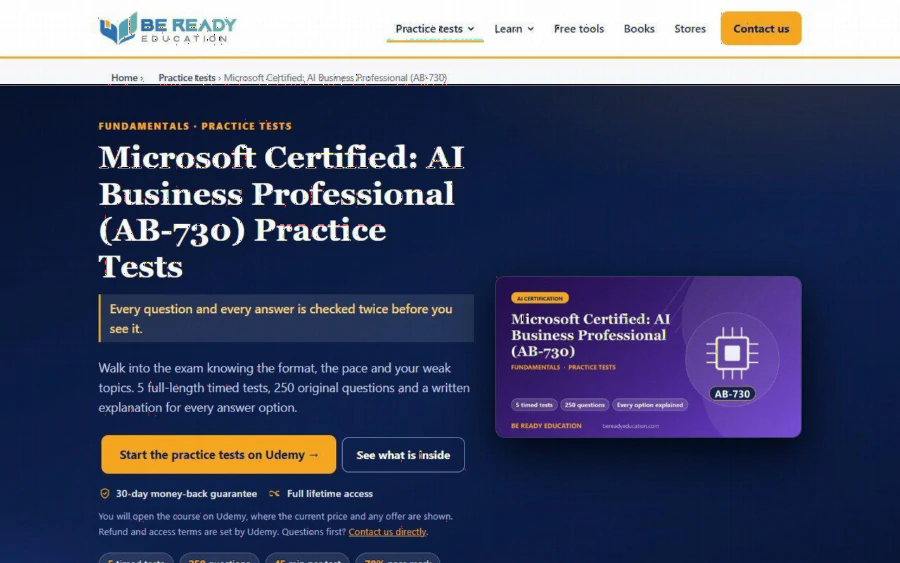
The AB-730 practice test page showing five timed tests, 250 questions and an explanation for every answer option
What the practice course gives you
The course behind the page is a set of independent practice tests, not an official Microsoft product. It is made up of five full-length timed tests with 50 questions each, 250 original questions in total, and 45 minutes per test. Every test has a 70 percent pass mark built into the practice scoring. The questions are written around the topics and style of the AB-730 exam. They are original and are not real exam content, which is the right way to do it and also means you should not expect to see the same wording on test day.
Three details matter more than the numbers.
Timing. Fifty questions in 45 minutes is about 54 seconds a question. The page points out that every test runs at that pace so the clock stops being a surprise. If you have only ever studied by reading slides or watching videos, the first timed paper is often a shock, and it is better to meet that shock at home.
Explanations for every option. Many practice sets only reveal the correct letter. Here, each question has a written explanation for the right answer and for each wrong one. That changes how you study, because a wrong answer becomes a small lesson about a trap rather than a mark you shrug off.
A readiness rule. The page suggests aiming for 80 percent or more on two tests in a row, and tracking each score against the 70 percent pass mark with a free tracker. It is more honest than a vague feeling of being ready.
Pairs that are easy to mix up
AB-730 questions often lean on ideas that sound alike. The exam page lists several pairs worth learning side by side, and they are a good model for how to study even if you never buy a practice test.
- Prebuilt agent or custom agent. A prebuilt agent is ready for a common scenario. A custom agent is created for a specific business process or knowledge source. Use the first when it already covers the task, and build the second when your workflow or data is particular to your organisation.
- Real-time catchup or intelligent recap. Catchup helps you get up to speed during a meeting that is still running. Recap summarises a meeting after it ends. Join late, use catchup. Review decisions afterwards, use recap.
- Copilot Pages or notebooks. Pages are for collaborating on content generated with Copilot. Notebooks organise chats, files and notes around a topic. Co-edit a deliverable in a page, and gather the background material in a notebook.
- Hallucination or prompt injection. A hallucination is the model producing inaccurate content on its own. Prompt injection is malicious or hidden instructions in content that try to steer the model. You counter the first with verification and citation checks, and the second by treating untrusted content with caution and keeping a human in the loop.
If you can explain each pair in your own words, you will handle a large share of fundamentals-level scenario questions. If you cannot, that is exactly the weak spot to practise on.
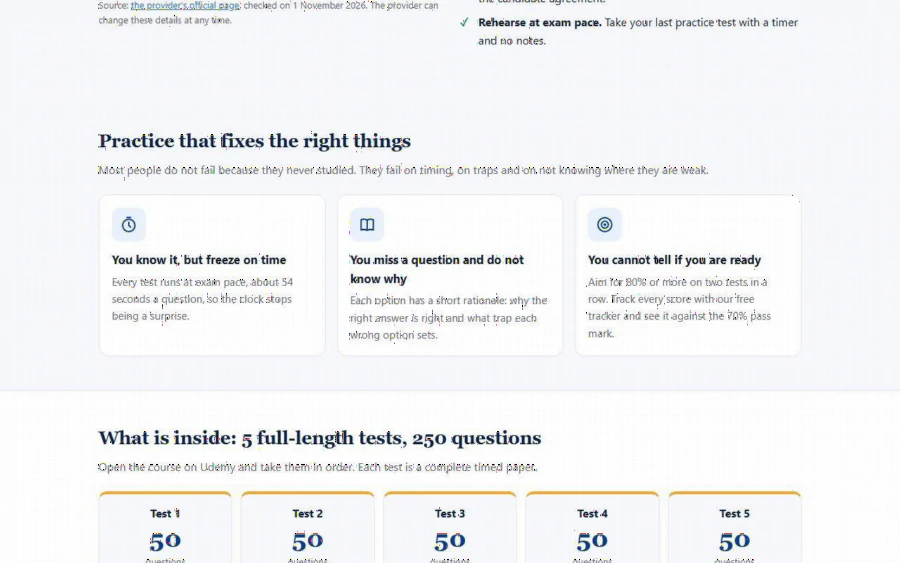
A section of the AB-730 page explaining why timing, traps and unclear readiness are the usual problems, with a description of how the tests address each
A scenario: the operations lead with two weeks
Picture an operations lead at a mid-sized company. She uses Copilot to summarise meetings and draft process notes, and her manager has asked the team to earn a recognised AI credential this quarter. She has two weeks and about 40 minutes on most weekdays.
Her plan could look like this. In the first two days she reads the provider's exam guide and writes down the objectives in her own words. Then she takes Test 1 cold, under the timer, without notes, and uses the explanations to sort her misses into three buckets: concepts she did not know, pairs she confused, and questions she simply ran out of time on. The next week she studies only the buckets, retakes nothing until she has fixed the gap, and then takes Tests 2 and 3. In the last few days she takes Tests 4 and 5 as dress rehearsals. If she scores 80 percent or more twice in a row, she books the exam. If she does not, she moves the date, which costs far less than a failed attempt.
This plan promises no pass and does not assume the practice questions match the real ones. The tests measure pace and weak topics, and the provider's guide stays the source of truth.
Limits you should know about
A practice course is not a substitute for hands-on use. If you have never opened Copilot Pages or created an agent, no set of questions will give you the same feel as ten minutes of real use in your own workspace. Do both.
The tests are also written for English-speaking candidates and are delivered through Udemy, so the price, any discount and refund terms are shown there and set by Udemy, not by the exam page. The page does mention a 30-day money-back guarantee and lifetime access, and it also says to check Udemy for current terms. Check the price when you open the course.
Finally, a certificate supports a job application. It does not guarantee a job. The page lists roles such as business analyst, project coordinator, marketing specialist, executive assistant using Copilot and finance or operations analyst as common places where this topic is relevant, and it says requirements vary by employer and country.
Who should use it, and who should not
This kind of practice suits professionals who already work with Microsoft 365 and Copilot and want to test themselves under exam conditions. It also suits career changers who learn best by answering questions and reading why they were wrong. If you like to study from sets of short explanations rather than long lectures, it fits.
It is a poor fit if you want a shortcut that skips understanding, if you expect leaked questions, or if you are aiming for a deep technical credential. For technical roles the same site points to the AI-901 and AI-103 tracks on Azure. If you want to lead AI change in a company, AB-731 is listed as the next step after AB-730, and PL-900 is suggested for adding low-code automation.
How to get started today
1. Open the exam guide on Microsoft's site and read the current objectives. Note the fee and the retake rules.
2. Look at the list of certification practice tests if you are unsure whether AB-730 is the right first exam. The catalogue currently shows 36 practice-test courses, each with five timed tests.
3. Take the first timed test with no notes. Do not worry about the score.
4. Sort every miss into knowledge, confusion or timing, and fix them in that order.
5. Take the remaining tests spaced out over several days, and track each score.
6. Book the exam only after two scores of 80 percent or more in a row, and confirm your ID, your set-up and the rules for breaks with the provider.
Preparation is mostly about removing surprises: the format, the pace and your weak spots.
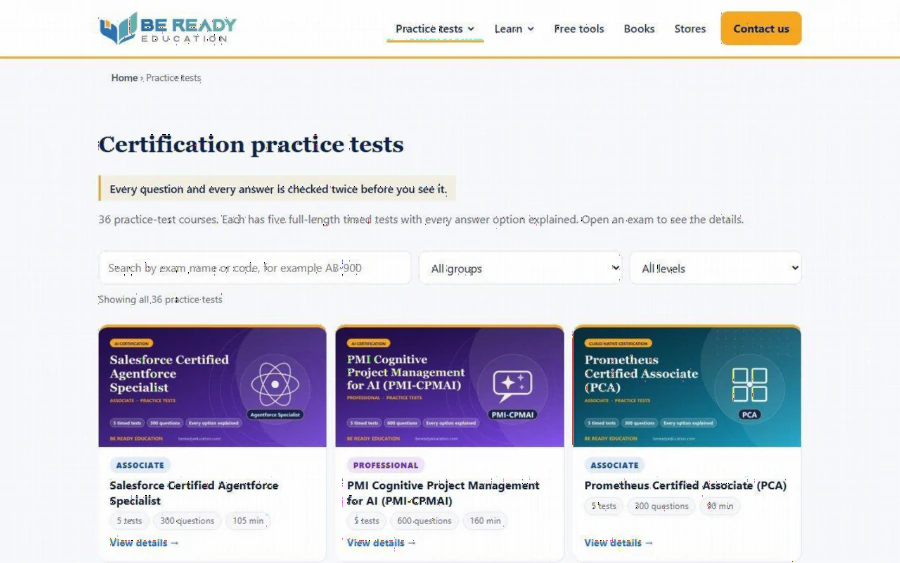
The Be Ready Education catalogue of certification practice tests, with course cards showing tests, question counts and time
*This article is an independent study guide. Be Ready Education is not affiliated with or endorsed by Microsoft. Always check the provider's official page for current exam details.*